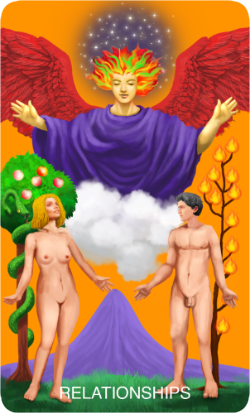
The traditional title of the Relationship Tarot card is Lovers. But this Tarot card does not only stand for love relationships, but all kinds of relationships.
The title and the picture show an ideal, spiritual, and harmonious relationship.
Despite the appearances to the contrary, we need to distinguish clearly between ourselves and others to have a good relationship with someone or something. A relationship is not a union, it is a partnership. It denotes mutual respect and exchange, sharing, and communication between the relationship participants. For this reason, ageless wisdom assigned the epithet disposing intelligence to this card.
To dispose means to set apart, arrange, order, position, and orient. The psychological term for this faculty of consciousness is relationship intelligence. Relationship intelligence encompasses knowing the motives, conflicts, and strengths of the members of a relationship and optimizing them.
Love makes blind, the saying goes. This is not true. Infatuation and obsession (emotions) make blind and lead to entanglements. Love is a feeling that disposes and clarifies. Love sees. If we love someone, we see beauty and ugliness, strengths and weaknesses, and perfections and imperfections. Love also sees the good in people that others and maybe even the concerned person aren’t aware of. That’s where the beautiful phrase I see you in Avatar comes from, which is a confession of love.
Clarity through disposition is the foundation on which we build functioning relationships. Think of the two poles of a battery. Only because their charges are clearly set apart can they generate electricity. If two lovers are properly set apart, their relationship will generate love. The opposite of clarity is confusion. Mind the etymology of confusion: Con means with, and fusion means blending.
80% of relationship problems are misunderstandings, and 20% are conflicts of interest. The roots of misunderstandings are entanglements and vagueness. Relationship disposition leads to tolerance, mutual respect, and communication, which eases the negotiation of conflicts of interest.
Communication is fundamental to cultural evolution. Think of ancient city-states. The city-states that traded the most, communicated the most, and thrived the most. In this respect, the Relationship card is the patron of communication and culture.
The Relationship card is also the patron of science. Despite the appearances to the contrary, the Relationship card is an intellectual card. The root of disposition is differentiation — the ability to tell things apart. Disposing takes differentiation to the next level by understanding the relationship between differentiated things. This allows us to measure things (no measurement, no science). Once measured, we can classify and systemize things, which is another scientific discipline.
Science explores the relationships between phenomena (what is observable) and physical and biological laws (invisible causes). Scientific equations show relationships. Mind, it’s impossible to observe an object in isolation. Science characterizes objects by observing how they interact with their environment, i.e., how they behave.
An auspicious Relationship card calls for untanglement, the clear dispositions of the members of a relationship. This automatically improves communication. Mind that we have relationships with people, things, businesses, situations, experiences, our body, and different aspects of our self.
Relationships allow us to share. In a sharing environment, it becomes difficult to tell what is ours and what is others’, and boundaries become fuzzy. In particular, in romantic relationships, we lose sight of boundaries. For this reason, an inauspicious Relationship card may indicate relationship trespassing, like the violation of privacy, autonomy, or freedom.
An inauspicious Relationship card may also indicate that a lack of relationship intelligence may have produced bad habits like disrespect, manipulation, neglect, poor communication, stonewalling, and blame-shifting.
On the Tree of Life, the path of the Relationship card connects the spheres Understanding (3’s) and the Higher Self (6’s), i.e., context and self-consciousness. The indigo halo stands for Understanding, the angel in the Relationship card stands for the higher self (6), the woman signifies creativity, and the man signifies intelligence. The woman reflects the higher self’s inspirations through the generation of thoughts, images, and desires. This means that intelligence does not have direct access to the higher self, but only through the creative-desirous faculty of consciousness.
The titles and the five core meanings of the Relationships card are:
Enlightenment Tarot title: Relationships
Traditional title: Lovers
Power of consciousness: Relating
Constructive use: Arrangement
Unconstructive use: Stereotypy, compartmentalization
Auspicious state of mind: Diversity
Inauspicious state of mind: Ambiguity
On the spiritual-intentional level, the Relationship card illustrates soulmateship.
On the creative-feely level, the Relationship card stands for devotion and our relationship with the Muse (angel) and art (woman).
On the intellectual level, the Relationship card stands for like-mindedness, infatuation, and conflict management — both internal and external.
On the bodily-practical level, the Relationship card stands for our relationship with our body and physical attraction. An inauspicious Relationship card may also indicate, in particular in children, sensitivity to the following afflictions: pulmonary diseases, pneumonia, pleurisy, asthma, bronchitis, arm/hand neuritis, and nervous affections of the respective body zone (see below).
More Attributions:
Number: 7
Letter: Zain, meaning sword (differentiation)
Astrology: Gemini
Color: Orange
Body zone: Arms, hands, shoulders, lungs, collarbones, and upper ribs.