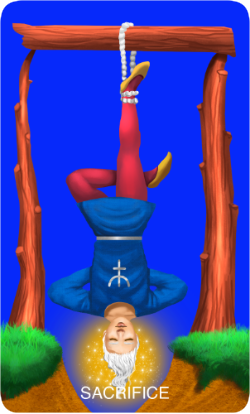
Hanged Man Upright: Correction
Sometimes we need to reverse our views to get closer to reality. The Hanged Man calls for considering new perspectives and sacrificing something lesser for something greater, such as giving up a cherished belief for the truth.
Hanged Man Reversed: Deceit
Deceit reverses truth through dishonesty, fabrication, or making others responsible for our mistakes. A reversed placement of the Hanged Man may indicate illusion, instability, or sacrificing what matters for something lesser.
Reversals and Sacrifices
We live in an upside-down world. To understand this, we need to consider the model of the four worlds. According to ageless wisdom, the world comprises four universes: Atziluth, Briah, Yetzirah, and Assiah. Assiah, the physical universe, is a reflection of Briah. Yetzirah, the world between the two, mirrors Briah to Assiah and puts everything on its head. That’s why Buddhists insist that the world we live in is an illusion.
This takes us to common sense. We derive common sense from the appearances of the physical world. Common sense helps with survival and success, but it is detrimental to philosophy and enlightenment. For instance, Planet Earth looks flat, we seem to be mortal, and consciousness appears to rely on bodies. The most fatal appearance is the sense of separation, the sense that we are on our own and that we have to compete with others for resources and attention.
To understand how things really are, we need to identify the invisible causes behind appearances, in particular, the causality of karma. The fact that the karma card precedes the Sacrifice card shows this.
That’s where science and enlightenment come in. Science proves that Planet Earth is round and revolves around the sun. Through enlightenment, we can verify that we are immortal souls and that our consciousness will survive the death of our bodies.
The power of consciousness of the Sacrifice card is reversal, for example, the reversal of commonsense notions.
For instance, we are used to thinking that other people or external conditions produce our challenges. In truth, adversity and resistance are karmic responses to weaknesses or inner demons. Remember that karma is the cosmic psychologist? Karmic lessons renew our understanding of causality. In this respect, the Sacrifice card calls for sacrificing blamestorming for shadow work.
Often, the truth turns out to be the exact opposite of what we believe (our world is upside down). For instance, the Sacrifice card calls for sacrificing the illusive sense of separation for the knowledge of the unity of life.
Ultimately, the Sacrifice card calls for reversing our understanding of sacrifice. A sacrifice does not mean giving up something. A sacrifice gives up the lesser for the greater, for example, giving up a cherished belief for the hard truth. Every (true) sacrifice leads to a gain.
The Sacrifice card may also suggest a reversal of a point of view. It suggests seeing things from the viewpoint of other people, in particular, those who oppose us. It also calls for considering new perspectives. In this case, the Sacrifice card calls for the sacrifice of our blinders for fresh perspectives.
Last but not least, the Sacrifice card calls for the sacrifice of the sense of personal intention. Personal intention is as fatal an illusion as the sense of separation. Intention originates in the higher self and flows through us. The white rope signifies the reliance on the higher self’s intention. The more transparent we are, the better cosmic intention can manifest. Unfortunately, the ego likes to get in the way. It thinks that it is the one intending and contaminates the higher self’s intention with its common sense and selfish wants.
Be careful when you explain this to your querents. This truth may upset the querent’s ego. She may feel that you’re taking away her free will. Of course, the reverse is true. By sacrificing the illusion of the ego’s free will, we can participate in the only free will there is: that of the higher self.
No sacrifice, no hero. If a billionaire gives a beggar a hundred thousand dollars, he does a selfless act, but he ain’t no hero because that kind of money is no sacrifice for him. Nelson Mandela was a hero because he sacrificed twenty-seven years of his life in prison for his goal to abolish apartheid. Oprah Winfrey sacrificed her privacy. Malala Yousafzai sacrificed her safety. Heroes achieve great things because they extend cosmic intention and sacrifice personal wants.
The gallows in the picture have the shape of the Hebrew letter Tau, which signifies the last Tarot card, Skill. In this context, the letter Tau signifies skill in reversal.
Have you ever had the sense that you were suspended in a certain situation, in particular, when you went into shock? The Sacrifice card signifies being suspended in a state of mind or a dream. Hence, the Sacrifice card can also signify dreams.
The hollowed earth at the bottom suggests a dry riverbed, which symbolizes habitual focus. Think of focus as an open faucet. The water that streams out of the faucet is straight and stable. That’s the reason ageless wisdom assigned the Hebrew letter Mem (water) and the epithet stable intelligence to this card. Now, replace water with consciousness.
An auspicious Sacrifice card calls for a reversal of opinion or point of view.
An auspicious Sacrifice card may also call for a sacrifice, a heroic act, and giving up the lesser for the greater.
An inauspicious Sacrifice card may indicate that taking things at face value, trusting in common sense, and holding on to outdated notions or methods may have caused the querent’s challenge.
An inauspicious Sacrifice card may also be an indicator of ill-intended reversal of truth, dishonesty, and the temptation to lie, fabricate, and make others responsible for one’s own mistakes.
Last but not least, an inauspicious Sacrifice card may indicate that the lesser usurped the greater. For instance, having a family calls for earning sufficient money. But money tempts, and the breadwinner may end up sacrificing family time for work. As you can see, the Sacrifice card has also to do with balancing. The figure in the picture is in equilibrium. Karma calibrated her and gave her stability.
On the Tree of Life, the path of the Sacrifice card connects the spheres Necessity (5’s) and Intelligence (8’s). The orange halo represents intelligence. Knowing and relying on applicable laws stabilizes thinking, which is naturally volatile. This connection also signifies being suspended by the laws that govern situations.
The titles and the five core meanings of the Sacrifice card are:
Enlightenment Tarot title: Sacrifice
Traditional title: Hanged Man
Power of consciousness: Reversal
Constructive use: Correction, rectification
Unconstructive use: Deceit
Auspicious state of mind: Stability, a sense of suspension, a sense of reality
Inauspicious state of mind: Instability, illusion
On the spiritual-intentional level, the Sacrifice card stands for samadhi, the suspension of the mind that gives way to revelations, visions, and mystical experiences. On the creative-feely level, the Sacrifice signifies being in the flow, meaning being absorbed in a creative activity during which we lose our sense of self. On the intellectual level, the Sacrifice card means cognitive reversal, the reversal of thoughts, POV, or perspectives, which leads to new insights. On the bodily-practical level, the Sacrifice card stands for self-restraint, i.e., the intelligent practices that restrain, redirect, or reverse bodily energy, which is usually burned up by worry, regret, ambition, stress, promiscuous sex, drugs, and consumerism. Yoga is such a practice that redirects and disciplines bodily energies. One can make the point that the figure in the picture is in a Yoga position.
More Attributions:
Number: 12
Letter: Mem, meaning water, in particular its reflective property
Astrology: Neptune
Color: blue
Explore all 78 cards and their meanings in the Tarot Map.