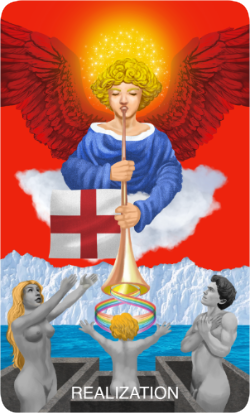
The Realization card represents both the realization of an aspect of reality and the realization of an undertaking. These two meanings correspond to adversity and resistance, the two types of challenges querents face, and the two directions on the Tree of Life. In both cases, the Realization card stands for the transcendence of a challenge.
Have you ever fully realized an undertaking and could say to yourself, I made it? Have you ever fully realized an aspect of reality and shouted like Archimedes, Eureka, I’ve found it? Then you have experienced the state of mind the Realization card represents. This beautiful moment is a moment of resurrection, or rather surrection. The three figures in the picture symbolize the surrection from a hitherto restricted state of mind or confining situation (the coffins) and the discovery of a new horizon.
The Realization card connects the Intellect with Materialization, which signifies karmic cycles. This is how karmic cycles look: thought → action → karmic feedback → analysis of the karmic feedback → adjustment of thoughts → new action → new karmic feedback. Karmic cycles go on as long as there is a discrepancy between how we think the external world works and how it actually does. Every karmic cycle, if gone through often enough, leads to a realization.
The discrepancy between how we think the world works and how it does produces tension, which psychologists call cognitive dissonance. Cognitive dissonances are one reason querents come to a Tarot reading.
Take the cognitive dissonance between religion and science as an example, the dissonance between belief and fact, which produces faith crises. Technically, a faith crisis is a simple thing. It occurs when that which is shown to us — an experience — contradicts that which we believe in.
Another classic example is the mystery of evil:
Is God willing to prevent evil, but not able? Then he is not omnipotent. Is he able, but not willing? Then he is malevolent. Is he both able and willing? Then whence cometh evil? Is he neither able nor willing? Then why call him God? – Epicurus
Cognitive dissonance preludes the judgment day of beliefs. Over time, reality always prevails and forces the intellect to adjust its opinions. The Realization card illustrates the moment reality surrects our intellect (the gray man) from a coffin of false belief.
The powers of consciousness of the Realization card and the Awakening card are essentially the same, but they represent different types and stages of cognitive dissonance. The Awakening card signifies cognitive dissonance between thoughts and desires (7 ↔ 8). The Realization card signifies cognitive dissonance between contradicting beliefs (8 ↔ 8) and beliefs and experiences (8 ↔ 10).
Also, the Awakening card awakens us to a fact, while the Realization card awakens us to reality. You can also think of Realization as a permanent awakening. This is the reason ageless wisdom assigned the epithet perpetual intelligence to this card.
Last but not least, the Realization card expands our horizons. Like the Awakening card, Realization causes a time of chaos, but that chaos doesn’t shock us, it produces a sense of awe.
The original title of this Tarot card is Judgment, which is a bit of a blind. This title does not signify moral judgment, especially not the so-called judgment day. That his card connects the Intellect and Materialization shows that the judgments in question are a practical and daily matter.
Good judgment is wise and uses good sense, i.e., the ability to evaluate a person, thing, or situation and the weighing of all factors involved. Also, judgment is empathetic and takes circumstances and history into consideration.
Religion and morality programmed condemnation into our subconsciousness, and that’s why we struggle to refrain from condemning people. Imagine someone steals money. The realization that the person stole is a judgment. Labeling that person a thief is a condemnation. Psychology is riddled with condemnations, too. If a person exhibits symptoms of depression, psychology pigeon-holes her as depressed. We all exhibit symptoms of depression once in a while. And we have all stolen. We are all sinners, and sinners forgive each other. Condemnation is a sin.
An auspicious Realization card calls for rational, unbiased, and well-thought-through judgment calls, resolving cognitive dissonance, and making unbiased judgment calls.
An auspicious Realization card also calls for coming out with the truth. The numerical correspondence indicates this. The number of this Tarot card is 20, which reduces to 2 (2+0=2). 2 is the number of the Truth card, hence, truth is the essence of realization. While the High Priestess is the patron of truth, the Realization card stands for the realization of truth. Surely, you have already experienced that liberating moment when you — after carrying around a lie for a long time — finally came out with the truth. Coming out of the closet (coffin) of sexual, religious, political, or other social conventions and standing up for the truth is indeed a transcending experience.
An inauspicious Realization card may indicate a faith crisis, that the querent is delaying judgment calls, is trying to eat a cake and have it, is (subconsciously) condemning people or situations, or refuses to come out of a coffin of misconception, delusion, misbelief, or misinterpretation.
An inauspicious Realization card may also signify that an opinionated judgment call, or worse, judgmentalism or condemnation, brought about the querent’s challenge.
Last but not least, it may indicate that the querent hesitates to reconcile beliefs and facts. Instead, she may keep them in separate departments and repress the corresponding cognitive dissonance.
On the Tree of Life, the path of the Realization card connects the sphere of the Intellect with the sphere of Materialization. The orange halo in the picture signifies the Intellect. The stone coffins symbolize Materialization, e.g., our three-dimensional, bodily awareness.
The titles and the five core meanings of the Realization card are:
Enlightenment Tarot title: Realization
Traditional title: Judgement
Power of consciousness: Realization
Constructive use: Judgment (calls), forgiveness
Unconstructive use: Judgmentalism, condemnation
Auspicious state of mind: Transcendence
Inauspicious state of mind: Mediocrity, mundanity
On the spiritual-intentional level, the Realization card stands for the sixth milestone of enlightenment, i.e., spiritual resurrection, spiritual transfiguration, and the transcendence of the limitations of the three-dimensional mind. The open coffins symbolize the birth of the four-dimensional consciousness of enlightened men and women.
On the creative-feely level, the Realization signifies creative realizations and the transcendence of mediocrity.
On the intellectual level, the Realization card represents the conquest of cognitive dissonance and the realization of the splendor of life. This gives way to cognitive harmony, cognitive consonance, and cognitive realization. An inauspicious Realization card stands for cognitive dissonance.
On the bodily-practical level, the Realization card stands for Kundalini, the force that is set up for the ruin of many, and the salvation of a few. On this level, the Realization card also signifies the effect thoughts have on our bodies.
More Attributions:
Number: 20
Letter: Shin, meaning tooth. Teeth break food and prepare it for digestion. Realization breaks down forms of consciousness,like thoughts, and releases their essences.
Astrology: Pluto
Color: red