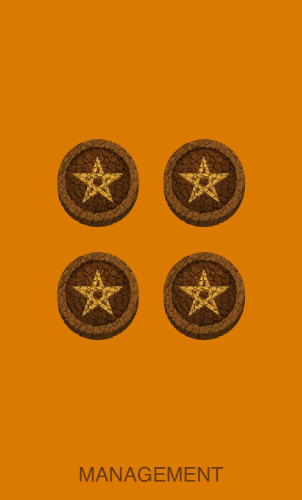
The Four of Pentacles represents grace on the bodily level of human expression. Four of Pentacles upright: management. Four of Pentacles reversed: manipulation.

The respective faculty of consciousness is management.
This takes us to an unexpected truth: proper management is benevolent. Hence, the opposite of management is oppressive control, aka drill, aka tyranny. Management leads to expansion, drill leads to contraction. Remember that the Three of Pentacles signifies organic growth? The Four of Pentacles stands for the benevolent management of organic growth.
The best leaders are benevolent. Think of Nelson Mandela or Mahatma Gandhi. Look for periods of peace and prosperity, and you will find benevolent leaders.
The Four of Pentacles raises the question whether we are managing or manipulating. A manager doesn’t run a business. He manages the people who run the business. If employees address a benevolent manager, she will ask, “How can I help?” Hence, the Four of Pentacles stands for people skills, too.
Mind, being benevolent doesn’t mean being soft. A benevolent leader knows when to say yes and when to say no. In fact, his nos are benevolent.
If you want to learn more about the advantages of benevolent management, listen to what Simon Sinek has to say.
Feng Shui promotes benevolent management. Feng Shui is the art of living in harmony with the energies of our environment (Three of Pentacles). This harmony promotes organic growth and resilience.
On the Tree of Life, the Four of Pentacles sits below the Two of Pentacles and serves as a receptacle for its wisdom. Hence, the Four of Pentacles also signifies wise management. Wise management means acting according to the right principles and prioritizing accordingly.
Wise management is orderly and measured. Measured means balanced. An important balance in business management is the balance between innovation and profitability. This is where the secondary meaning of economy in the arrangement of material affairs comes from.
The same is true for education. Benevolent education fosters the physical and mental growth of children. Mind parents can give their children only opportunities to learn, e.g., by putting them in schools, paying for music lessons, and motivating them to practice. The children need to walk the walk. In the case of oppressive education (censorship), parents don’t let their children walk the walk. In the case of too much benevolence (leniency), the parents don’t motivate their children enough.
The Four of Pentacles calls for practical and benevolent management of personal affairs, circumstances, situations, and relationships.
An inauspicious Four of Pentacles may signify an oppressive attitude toward circumstances, others, and oneself. You may know the latter as somatic tyranny, which refers to an oppressive attitude toward one’s body, which can manifest as self-harm, anorexia, or compulsive overexercising.
Four of Pentacles Symbolism

The four pentacles in the picture assume a rectangular arrangement, which signals order.
Benevolent management is orderly, structured, and rests on wisdom — the knowledge of the principles that pertain to the affairs we want to manage.
The rectangle also suggests boundaries, which protect and preserve. Yes, boundaries can and should be benevolent.
The arrangement also suggests the four sides of a window. The fourth major arcana, the Reason/Emperor card, relates to the Hebrew letter Heh, which means window. We look at life through various windows or perspectives, like the window of our nationality, education, or religion. Our windows influence (and limit) our perception. Understanding our perspectives and valuing their relative importance is an essential prerequisite for benevolent management.
The Five Psychological Core Meanings of the Four of Pentacles
We derive the psychological meanings of Tarot cards from their position on the Tree of Life. In the Enlightenment Tarot framework, the Four of Pentacles represents Chesed of Malkuth, i.e., grace and benevolence on the bodily-practical level of human expression.
Every Tarot card represents a faculty or power of consciousness. We can use faculties of consciousness constructively and destructively, which produces either a fortunate or an adverse state of mind. Hence, every Tarot card has five core meanings.
These are the five core meanings of the Four of Pentacles:
- Power of consciousness: Management
- Constructive use: Benevolent management
- Unconstructive use: Manipulation
- Auspicious state of mind: Concord
- Inauspicious state of mind: Discord
Reflective Questions
If the Four of Pentacles appears in your spread, it may be beneficial to ask yourself the following questions:
- Which affairs do I manage, and which affairs do I manipulate?
- Which area of my life calls for benevolent management rather than fixed rules?
- How can I support others without pressure?
- Where does fear cause a contraction and block or undo expansion?
- Which part of my daily life suffers under inner tyranny, and how can I restore benevolence?
- Where do I confuse help with interference or guidance with manipulation?
- Which relationship in my life could thrive more when I acted as a benevolent manager, and not as a controller?
- How well can I balance innovation and risk management?
Four of Pentacles Summary
The Four of Pentacles calls for managing our incarnations with goodwill, according to benevolent principles, and receptivity to grace.
Where Do Tarot Card Meanings Actually Come From?
The meanings of Tarot cards come from various sources. The most common are:
- The position of the Tarot cards on the Tree of Life
- Astrological correspondences (signs, planets, & houses)
- The symbolism of Tarot cards
- Intuition
- Meanings that pertain to fortune-telling
Most of the Tarot card meanings you can google are astrological correspondences and go back to the Golden Dawn and Arthur Edward Waite. Astrological meanings have dominated because Astrology favors fortune-telling. But Astrological meanings are unsuitable for (psychological) Tarot readings.
If you are interested in an overview of the astrological correspondences, you can download a high-resolution chart by subscribing to the Enlightenment Tarot.
Tarot card meanings are a bit of a mess since the meanings that pertain to their position on the Tree of Life mingle with astrological correspondences, symbolic interpretations, and fortune-telling connotations. That’s tedious to memorize. Further, tarotists’ opinions, knowledge, and linguistic backgrounds shaped some of these interpretations. Last but not least, many meanings are fuzzy, contradictory, and overlapping. If you want to understand why they overlap, read the article How to Deal With the Overlapping Meanings of Tarot Cards.
The meanings of the Enlightenment Tarot are based on an objective and holistic framework: the Tree of Life and the four levels of human expression. The resulting meanings are transparent and logical and, hence, easier to memorize.
What Various Tarotists Say about the Meanings of the Four of Pentacles
Let’s explore what various tarotists wrote about the Four of Pentacles.
Tarotists emphasize the astrological significance of Tarot cards since these lend themselves to divination and fortune-telling.
The Four of Pentacles corresponds to the third decanate of Capricorn, ruled by Saturn, and sub-ruled by Virgo and Mercury.
The main Capricorn characteristics are: ambitious, diplomatic, and conservative. The second decanate adds the following vibes to the mix: profound, aloof, and tight-lipped.

The two corresponding Tarot cards are the Adversity and Hermit cards. This gives us a combination of the serious-practical Capricorn vibes with the intellectual-scholastic Virgo vibes.
Capricorn rules the 10th house, the house of material affairs and business, aka the house of social status. This house governs worldly ambition and standing, businesses, career, professional goals, occupation, and business, as well as the results thereof, like success, achievements, awards, reputation, expertise, and worldly authority. It is also the house of adversity, which governs the problems, conflicts, and difficulties that come with the pursuit of material gain.
Virgo rules the sixth house, the house of responsibilities and routines, aka the house of health. This house governs employment and other services we provide. This includes health matters — the responsibilities we have toward our bodies and minds. The sixth house also governs worldly education and literacy, and the knowledge we need to assume our responsibilities. The hermit holds up the light of wisdom. This light symbolizes our responsibility toward our own evolution and that of our fellow men.
What Paul Foster Case Said About the Meanings of the Four of Pentacles
For the Four of Pentacles, Paul Foster Case proposed the keyword management.
He added that this card denotes the skill to direct physical forces.
The Four of Pentacles may signify an acute, penetrating, and tactful temperament (a Virgo talent), economy in the arrangement of material affairs (combined Virgo and Capricorn talents), and activity in money matters (the 10th house).
An inauspicious Four of Pentacles may indicate dangers to reputation (10th house), troubles through changes not carefully considered (lack of Virgo talents), and the desire for money but unwise money management (keyword and lack of Capricorn talent).
The Four of Pentacles may foretell opportunities for public service (10th house), and, if inauspicious, that the querent will meet sharp criticism.
What Arthur Edward Waite Said About the Meanings of the Four of Pentacles

Arthur Edward Waite wrote that the Four of Pentacles indicates the surety of possession (wise management) and the clinging to one’s possessions (Capricornian materialism).
The respective faculty of consciousness is observation. This is a wise interpretation, since management builds on thorough observation.
The Four of Pentacles may foretell gifts, legacy, and inheritance, and, for a bachelor, pleasant news from a lady. The opportunity for gifts goes back to the basic faculty of consciousness, which is grace. One could think of legacy and inheritance of gifts, too, but these are usually affairs of the 8th house (Scorpio).
It is unclear how Arthur arrived at the meaning of pleasant news from a lady. The astrological associations don’t support this.
An inauspicious Four of Pentacles may signify suspense, delay, opposition, and hindrances. These are consequences of unwise management.
The arrangement of the Pentacles in the picture is unusual and does not conform to the position of the spheres of the Tree of Life around the body. Arthur’s positions indicate the first sphere above the head (intention), the sixth sphere at the heart (self-consciousness), and the tenth sphere at the feet (materialization). In particular, the two pentacles at the feet are unusual. Having said that, astrologically, the feet symbolize understanding – understanding resulting from walking the path of life and gaining experiences. Experiences bring empathy and competence, which serve wise management.
What Etteilla Said About the Meanings of the Four of Pentacles
Etteilla, a French occultist, wrote that the Four of Pentacles may foretell a gift or obstruction.
Gift goes back to grace, and obstruction is a consequence of unwise management.
What Papus Said About the Meanings of the Four of Pentacles
Papus, another French occultist and the founder of the Martinist Order, wrote that this card may foretell the loss of money.
This is a rather sweeping assessment of the card’s connection with the 10th house of business. One may also wonder why Papus gave only the inauspicious meaning, in particular, since this card represents grace.
What Gregor Mather Said About the Meanings of the Four of Pentacles
Gregor Mather, the founder of the Golden Dawn, believed that an auspicious Four of Pentacles signifies pleasure, gaiety, enjoyment, and satisfaction.
It is unclear how Gregor arrived at these meanings. These are emotional responses to success. Maybe he considered the emotional response to grace.
An inauspicious Four of Pentacles shall indicate obstacles and hindrances. While these are rather matters of adversity and karma, one may consider them as consequences of unwise management.
What Mme. Le Marchand Said About the Meanings of the Four of Pentacles
Mme. Le Marchand, a celebrated 19th-century Parisian fortune teller, believed that the Four of Pentacles foretells that the querent will receive a flower from a loving hand.
The first rose presented to her will tell her that she is entering the rosy month of love. If she cherishes the flower faithfully, it will bring her good fortune and happiness.
With this, Mme. Le Marchand limits her interpretation of this card to romantic grace.
The Psychological Framework of the Enlightenment Tarot
Every Tarot card represents a faculty of consciousness. We can use faculties of consciousness constructively and destructively. This produces favorable and adverse experiences.
We can express faculties of consciousness on four levels:
- The spiritual level (wands/fire/intention)
- The creative-feely level (cups/water/imagination)
- The intellectual level (swords/air/intelligence)
- The bodily level (pentacles/earth/bodily action)
The four tools on the magician’s table symbolize these four levels:
- The wand (spiritual)
- The cup (creative-feely)
- The sword (intellectual)
- The pentagram (bodily)

These tools correspond to the four so-called elements: fire, water, air, and earth.
For this reason, the Enlightenment Tarot wands are made of fire, the cups consist of water, and the pentacles are composed of earth. Unfortunately, it’s impossible to illustrate something made of air, since air is invisible. For that reason, all swords are made of crystal to show at least transparency.
The Enlightenment Tarot derives its meaning from the Tree of Life and the four levels of human expression. This is an objective holistic framework that reveals the psychological imports of Tarot cards and their faculties of consciousness. Read more about this framework in the article The Psychological Framework of the Enlightenment Tarot.
The Enlightenment Tarot project attempts to rediscover the original meanings of the Tarot cards that pertain to their position on the Tree of Life. These meanings are simple, clear, and easy to memorize.
*This framework is compatible with Paul Foster Case’s qabalistic system.
Do you want to learn more About The Enlightenment Tarot?
If you want to delve deep into the psychological meanings of Tarot cards, read the book Tarot of Life.
If you are curious about how the Enlightenment Tarot came about, read this article.
If you are interested in learning how to perform psychological Tarot readings, subscribe to receive a free copy of a guide on how to perform psychological Tarot readings.
If you are looking for a psychological Tarot deck, you have come to the right place. The Enlightenment Tarot derives the cards’ meanings from a holistic and transparent framework that is easy to learn and memorize. All major and minor arcana carry psychological titles, and the court cards display psychological profiles. Have a look at the Enlightenment Tarot deck here.
#Four of Pentacles #Four of Pentacles meaning #Four of Pentacles Tarot interpretation #Four of Pentacles upright #Four of Pentacles reversed #Four of Pentacles symbolism #Four of Pentacles spiritual significance #Four of Pentacles in Tarot spreads #Four of Pentacles energy and inspiration #Chesed #Grace #Mercy #Body

Delve into the psychological mysteries of the Tarot with the Enlightenment Tarot deck — a contemporary Tarot deck with authentic Tarot symbolism yet immersive illustrations designed for psychological Tarot readings.
Trace your querent’s challenges back to her weaknesses or inner demons. Shadow work made easy.
This exceptional Tarot deck is based on an objective and holistic psychological framework: the Tree of Life. All minor and major cards feature psychological titles. For example, the Magician has the title ‘Attention’, and the Six of Cups has the title ‘Decision’. The court cards exhibit psychological profiles. For instance, the Queen of Wands stands for a willful woman: generous or stubborn, resolute or revengeful, intense or tyrannical, magnetic or dangerous.