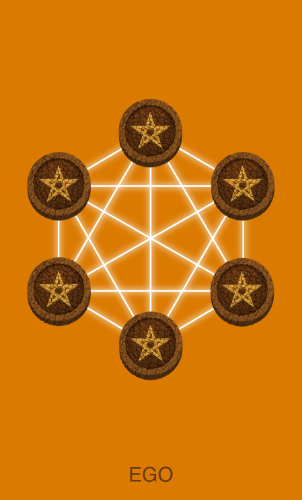
The Six of Pentacles represents self-consciousness on the bodily-practical level of human expression. Six of Pentacles upright: self-discovery. Six of Pentacles reversed: egoism.

The respective body part is the heart and the intrinsic cardiac nervous system(the heart’s brain), which is connected to the heart chakra.
Each of the four levels of human expression has a different type of self-consciousness. The Six of Wands represents the human spirit. The Six of Cups stands for the soul. The Six of Swords illustrates the intellectual ego, and the Six of Pentacles signifies the bodily ego.
Buddhists claim the ego doesn’t exist. That’s inaccurate. The ego is an illusion all right, but it’s not non-existent. And although it is an illusion, it still plays an important role in the architecture of the human self. For one, without it, we couldn’t survive or succeed. The lifestyle of Buddhist monks confirms this. They practice non-ego and, as a result, can only survive in monasteries.
On a side note, since the ego is an illusion, it doesn’t appear in any Tarot card. Tarot card personas either represent the higher self (angel), creativity/desires (woman), or intelligence (man).
The two most important ego functions are relating experiences and maintaining a notion of self.
If our egos didn’t relate experiences to itself, we couldn’t survive. A curious soul would look at an approaching lion and think, “Awesome, wonderful, beautiful,” and it would be dead. To support the ego in survival matters, the body subjects it to emotions like fear, anger, or disgust. The body also subjects the ego to hunger, thirst, and pain, which compels the ego to supply the body with the nutrition it needs, a safe place to sleep, and company.
Have you ever met a person who makes everything about herself? That’s the ego’s experience-relating function on hyperdrive. The ego takes everything personally. The psychological term for this is main character syndrome.
The ego needs a sense of I to relate experiences to itself. This self-identification is a fragile illusion. It is a cloud of things it identifies itself with, like the body, the gender, character traits, family role, job, house, car, nationality, and so on. If it loses or questions one or more of these identity bits, the ego enters an identity crisis.
The ego is one of these things we can’t live with and can’t live without. We need it to survive and succeed, but the ego also causes endless headaches, in particular, psychological headaches. Most psychological issues are ego issues.
Despite its fragility, the ego is an amazing survivor. It is the phoenix, which rises from its ashes again and again. Take so-called mental health problems as an example. They arise when an experience injures the ego’s self-identification, for example, a traumatic experience that leads to a faith crisis. In such cases, the ego resorts to psychological maneuvers like depression, anxiety, and PTSD to keep its self-identification together. So-called mental health problems are not defects, they are self-preservation maneuvers.
One of the most common self-preservation mechanisms is pride. Ever heard that pride is a sin? Pride impedes the renewal of a damaged or out-lived self-identification. Pride also prevents the ego from reaching out to the higher self and enjoying its guidance and protection. The opposite of pride is honor, i.e., self-esteem based on accomplishments.
Keeping it together may work short-term, but this prolongs identity crises and causes suffering. Long-term damage to the ego’s self-identification requires transformation and renewal. That’s where therapy comes in. Mind the sixth sphere emanates the path of the Transformation card and the path of the renewing intelligence, which the Adversity card illustrates (see the picture below).
Remember that the Six of Wands stands for empathy? The Six of Pentacles signifies applied empathy, e.g., respect and care. This is where the meanings of discretion and diplomacy come in. It also calls for philanthropy. This is where the secondary meanings of giving, sharing wealth, generosity, charity, gifts, presents, donations, help, support, and kindness come from.
An auspicious Six of Pentacles calls for philanthropy and ego work, in particular, sorting out identity crises. This may call for a transformation of the querent’s self-identification. A neighboring Transformation card can confirm this.
Accordingly, an inauspicious Six of Pentacles may indicate selfishness. That’s where the secondary meanings of ambition, craving, greed, envy, and jealousy come from.
An inauspicious Six of Pentacles may also signify a sense of worthlessness, helplessness, and hopelessness. We are used to thinking that a lack of success causes a sense of worthlessness. That successful people commit suicide proves that success doesn’t lead to a sense of worth.
Six of Pentacles Symbolism

The six pentacles in the picture form a hexagon that contains a hexagram.
We know from the Six of Wands that the hexagram combines two equilateral triangles, one pointing upward and one pointing downward.
On the bodily-practical level (pentagrams), the two triangles represent the union of the higher self and the ego. Hence, the symbolism indicates intuition in practical matters.
The two triangles also symbolize the downward and upward movements on the Tree of Life — activity and experiencing, but on the bodily-practical level. These are bodily actions and the perception of experiences. The perception of experiences implies valuing experience, whether they are beneficial or hostile. This does not include the interpretation of experiences, which happens on the intellectual level.
The Five Psychological Core Meanings of the Six of Pentacles
We derive the psychological meanings of Tarot cards from their position on the Tree of Life. In the Enlightenment Tarot framework, the Six of Pentacles represents Tiphareth of Malkuth, i.e., self-consciousness on the bodily-practical level of human expression.
Every Tarot card represents a faculty or power of consciousness. We can use faculties of consciousness constructively and destructively, which produces either a fortunate or an adverse state of mind. Hence, every Tarot card has five core meanings.
These are the five core meanings of the Six of Pentacles:
- Power of consciousness: Self-identification
- Constructive use: Self-discovery
- Unconstructive use: Egoism
- Auspicious state of mind: Self-understanding
- Inauspicious state of mind: Identity crisis
Reflective Questions
If the Six of Pentacles appears in your spread, it may be beneficial to ask yourself the following questions:
- On what do I base my sense of self right now: on my roles, achievements, or the values I hold dear?
- Which parts of my identity feel stable, threatened, or outdated?
- What do I take personally, and what makes me feel offended, even if it’s not about me?
- How do fear, anger, or pride guide my practical decisions in daily life?
- How do I react when someone questions or challenges my self-image?
- What does generosity mean to me beyond money or material support?
- Where do I confuse self-worth with success, status, or approval?
- In which area of my life does the renewal of identity feel necessary but meets internal resistance?
- How could empathy toward others improve my relationship with myself?
Six of Pentacles Summary
The Six of Pentacles invites the ego to mature through self-understanding, connecting to the higher self, and exercising self-humor.
Where Do Tarot Card Meanings Actually Come From?
The meanings of Tarot cards come from various sources. The most common are:
- The position of the Tarot cards on the Tree of Life
- Astrological correspondences (signs, planets, & houses)
- The symbolism of Tarot cards
- Intuition
- Meanings that pertain to fortune-telling
Most of the Tarot card meanings you can google are astrological correspondences and go back to the Golden Dawn and Arthur Edward Waite. Astrological meanings have dominated because Astrology favors fortune-telling. But Astrological meanings are unsuitable for (psychological) Tarot readings.
If you are interested in an overview of the astrological correspondences, you can download a high-resolution chart by subscribing to the Enlightenment Tarot.
Tarot card meanings are a bit of a mess since the meanings that pertain to their position on the Tree of Life mingle with astrological correspondences, symbolic interpretations, and fortune-telling connotations. That’s tedious to memorize. Further, tarotists’ opinions, knowledge, and linguistic backgrounds shaped some of these interpretations. Last but not least, many meanings are fuzzy, contradictory, and overlapping. If you want to understand why they overlap, read the article How to Deal With the Overlapping Meanings of Tarot Cards.
The meanings of the Enlightenment Tarot are based on an objective and holistic framework: the Tree of Life and the four levels of human expression. The resulting meanings are transparent and logical and, hence, easier to memorize.
What Various Tarotists Say about the Meanings of the Six of Pentacles
Let’s explore what various tarotists wrote about the Six of Pentacles.
Tarotists emphasize the astrological significance of Tarot cards since these lend themselves to divination and fortune-telling.
The Six of Pentacles corresponds to the second decanate of Taurus, ruled by Venus and sub-ruled by Virgo and Mercury, which addsintelligence and literacy to the artistic Taurian talents.
The main Taurian characteristics are: determined, practical, and dutiful. The Virgo influence adds the following vibes to the mix: deliberate, constructive, and conservative.
The corresponding Tarot cards are the Intuition or Hierophant card and the Attainment or Hermit card.

These two images convey a powerful, benevolent influence. The hierophant represents the higher self that guides, protects, and inspires humans, while the hermit holds out the light of ageless wisdom that guides people on the path of enlightenment.
Taurus rules the 2nd house, the house of creativity, aka the house of fortune. Fortune is a bit misleading, since it pertains to much more than just earning money.
Venus rules Taurus. Taurians are hard-working artisans. We don’t find fortune, we create it. Mind that fortune is a wildcard. For those who are after money, fortune means money. For scientists, fortune means knowledge. For those pursuing enlightenment, fortune is enlightenment.
The Hierophant is the revealer of the mysteries. She reveals to us what true fortune is and how to acquire it. Mind the Hierophant is the patron of Tarot readings.
Virgo rules the sixth house of responsibilities and routines, aka the house of health. This house governs employment and other services we provide. This includes health matters — the responsibilities we have toward our body and mind. This house also governs worldly education, literacy, and the knowledge we need to assume our responsibilities.
What Paul Foster Case Said About the Meanings of the Six of Pentacles
For the Six of Pentacles, Paul Foster Case proposed the keywords prosperity and presents.
This conforms to the benevolent influence of the hierophant and hermit. From these keywords, he deduced the important secondary meaning of philanthropy (the opposite of egoism).
Paul’s other secondary, auspicious meanings are: practicality and determination (Taurus), discretion and diplomacy (Virgo), gain by letters, writing, travel, speaking, teaching, commissions, and through advertising, as well as study, books, and all other things ruled by Mercury. The latter meanings pertain to the Mercury influence in Virgo. Mercury rules Virgo and is also exalted therein.
Paul’s inauspicious meanings are losses through the same things through an unbalanced Mercury influence, like over-thinking.
What Arthur Edward Waite Said About the Meanings of the Six of Pentacles

Like Paul, Arthur Edward Waite believed the Six of Pentacles signifies presents, prosperity, and gifts, and the gratification that results from these. The imagery in the picture illustrates these ideas.
Mind that charity may not always be motivated by philanthropy, but may serve to boost pride instead. The image of the scales indicates that the charity in question is measured.
Arthur added that the querent shouldn’t rely on the present, should still make efforts to overcome her adversity, and should not delay her actions.
Like Paul, Arthur also honors the Mercury influence in Virgo by offering the meanings of attention and vigilance.
Arthur also considered the Venus influence in Taurus by suggesting the meaning of desire, and, if the card turns up inauspicious, greed, envy, jealousy, and illusion.
Last but not least, Arthur wrote that the Six of Pentacles heeds the warning to check one’s ambition, which also goes back to an inauspicious Venusian influence.
What Etteilla Said About the Meanings of the Six of Pentacles
Etteilla, a French occultist, wrote that the Six of Pentacles may signify ambition and a warning to heed one’s surroundings.
Ambition pertains to the Venus influence in Taurus, and heeding one’s surroundings or circumstances is a Mercurial talent. The latter isn’t specific to the Six of Pentacles and may apply to other Tarot cards with a Mercurial influence as well.
What Papus Said About the Meanings of the Six of Pentacles
Papus, another French occultist and the founder of the Martinist Order, wrote that this card may indicate ruin.
With this, he emphasizes the inauspicious meaning of the Six of Pentacles, ruin being the opposite of presents.
However, since adversities are blessings in disguise, we may think of the auspicious meaning of this card as the gift of ruin.
What Gregor Mather Said About the Meanings of the Six of Pentacles
Gregor Mather, the founder of the Golden Dawn, also believed that an auspicious Six of Pentacles signifies presents, gifts, and gratification.
Like Arthur, Gregor proposed the following inauspicious meanings: ambition, desire, passion, aim, and longing, which all pertain to an unbalanced Venusian influence.
What Mme. Le Marchand Said About the Meanings of the Six of Pentacles
Mme. Le Marchand, a celebrated 19th-century Parisian fortune teller, believed that the Six of Pentacles reveals an unhappy marriage and an upcoming divorce.
Alternatively, it may foretell the separation from an old friend or a kind female friend.
This leans toward fortune-telling, however, Mme. Le Marchand still honored the Venus influence of this card.
The Psychological Framework of the Enlightenment Tarot
Every Tarot card represents a faculty of consciousness. We can use faculties of consciousness constructively and destructively. This produces favorable and adverse experiences.
We can express faculties of consciousness on four levels:
- The spiritual level (wands/fire/intention)
- The creative-feely level (cups/water/imagination)
- The intellectual level (swords/air/intelligence)
- The bodily level (pentacles/earth/bodily action)
The four tools on the magician’s table symbolize these four levels:
- The wand (spiritual)
- The cup (creative-feely)
- The sword (intellectual)
- The pentagram (bodily)

These tools correspond to the four so-called elements: fire, water, air, and earth.
For this reason, the Enlightenment Tarot wands are made of fire, the cups consist of water, and the pentacles are composed of earth. Unfortunately, it’s impossible to illustrate something made of air, since air is invisible. For that reason, all swords are made of crystal to show at least transparency.
The Enlightenment Tarot derives its meaning from the Tree of Life and the four levels of human expression. This is an objective holistic framework that reveals the psychological imports of Tarot cards and their faculties of consciousness. Read more about this framework in the article The Psychological Framework of the Enlightenment Tarot.
The Enlightenment Tarot project attempts to rediscover the original meanings of the Tarot cards that pertain to their position on the Tree of Life. These meanings are simple, clear, and easy to memorize.
*This framework is compatible with Paul Foster Case’s qabalistic system.
Do you want to learn more About The Enlightenment Tarot?
If you want to delve deep into the psychological meanings of Tarot cards, read the book Tarot of Life.
If you are curious about how the Enlightenment Tarot came about, read this article.
If you are interested in learning how to perform psychological Tarot readings, subscribe to receive a free copy of a guide on how to perform psychological Tarot readings.
If you are looking for a psychological Tarot deck, you have come to the right place. The Enlightenment Tarot derives the cards’ meanings from a holistic and transparent framework that is easy to learn and memorize. All major and minor arcana carry psychological titles, and the court cards display psychological profiles. Have a look at the Enlightenment Tarot deck here.
#Six of Pentacles #Six of Pentacles meaning #Six of Pentacles Tarot interpretation #Six of Pentacles upright #Six of Pentacles reversed #Six of Pentacles symbolism #Six of Pentacles spiritual significance #Six of Pentacles in Tarot spreads #Six of Pentacles energy and inspiration #Geburah #Law #Severity #Fear #Body

Delve into the psychological mysteries of the Tarot with the Enlightenment Tarot deck — a contemporary Tarot deck with authentic Tarot symbolism yet immersive illustrations designed for psychological Tarot readings.
Trace your querent’s challenges back to her weaknesses or inner demons. Shadow work made easy.
This exceptional Tarot deck is based on an objective and holistic psychological framework: the Tree of Life. All minor and major cards feature psychological titles. For example, the Magician has the title ‘Attention’, and the Six of Cups has the title ‘Decision’. The court cards exhibit psychological profiles. For instance, the Queen of Wands stands for a willful woman: generous or stubborn, resolute or revengeful, intense or tyrannical, magnetic or dangerous.