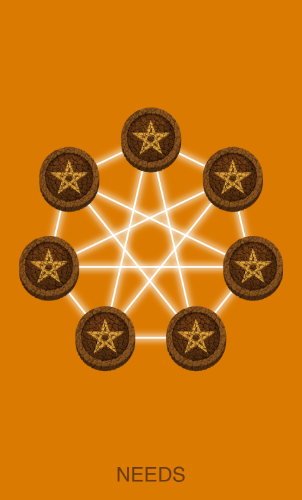
The Seven of Pentacles represents desires on the bodily-practical level of human expression. Seven of Pentacles upright: frugality. Seven of Pentacles reversed: consumerism.

On the bodily level, desires become needs, like the need to eat, sleep, and mate. Accordingly, the corresponding faculty of consciousness is provisioning, the supply of what is necessary to sustain the body and desired circumstances.
Many businesses address needs. To increase revenue, businesses commodify needs by promoting consumerism, for example, by selling tap water in bottles.
Psychologically, the Seven of Pentacles represents the sense of success. The sense of success is an internal response to external accomplishments. This is where the secondary meanings of fruition, payoff, harvest, rewards, profits, results, payouts, and fortune come from.
On the bodily level, creativity becomes resourcefulness and ingenuity, which makes use of bodily skills, like manual skills or athletic skills.
The Seven of Pentacles stands for emotions, too. The body reacts to experiences with emotions like fear, disgust, and infatuation. Emotions are involuntary, and we need to manage them (Four of Pentacles), for example, by formulating motivating affirmations and reframing experiences. Reframing experiences can be life-changing. For instance, a colleague’s criticism may make us think she believes we’re incompetent. Our body reacts to that with embarrassment and anger. We can reframe the situation by considering that our colleague wants to help us succeed and that she spares time and energy to do so. To that reframed thought, our body would react with appreciation.
We can manage our emotions also through emotional distancing. We can’t prevent emotional reactions, but we can distance ourselves from them. For instance, when we get angry, we may take a few deep breaths or do another anger management practice. If you want to learn more about this, watch the YouTube video Emotional Distancing.
In this context, the Seven of Pentacles corresponds to positive psychology. While classical psychology banks on intelligence (Hod) to overcome negative character traits, positive psychology has a creative approach and takes people to a positive state of mind, mental well-being, and happiness.
Positive emotions like excitement can motivate us. This is where the secondary meanings of hard work, perseverance, and diligence come from. Negative emotions can motivate, too, like hate or the urge for revenge.
An auspicious Seven of Pentacles calls for developing emotional intelligence. An inauspicious Seven of Pentacles may indicate emotional imbalances, and even a borderline personality disorder, as well as emotional inner demons, like greed, anger, or hate.
An inauspicious Seven of Pentacles may also signify consumerism, materialism, appetites, addictions, hoarding, etc. To draw the line, ask yourself whether you need what you desire. If you don’t need it, think twice about getting it. This is not a simple distinction. For instance, the body just needs healthy food, but the soul may need dining once in a while.
An inauspicious Seven of Pentacles may also signify a sense of lack, i.e., the sense of being incomplete or lacking things. We can overcome the sense of lack by practicing gratitude. If you want to be happy, be grateful. What about practicing gratitude in the morning by listing all the things you appreciate?
An inauspicious Seven of Pentacles may signify that the querent’s achievements don’t give her a sense of success, too. Buying a Gucci bag or getting a raise may be satisfying, but this type of satisfaction is short-lived and leaves the soul starving. This may lead to a lingering sense of emptiness, boredom, and misery. The dissatisfaction of the soul is intangible but intense and can make itself felt as depression, anger, and/or anxiety.
If the querent’s question pertains to adversity, the Seven of Pentacles may indicate that the adversity in question is a consequence of making emotional decisions, a lack of (practical) creativity, or greed.
Since emotional habits make up our attitudes, an inauspicious Seven of Pentacles may also signify that a bad attitude caused the querent’s challenge.
Alternatively, an inauspicious Seven of Pentacles may indicate a lack of motivation to act, which can lead to failure. This is where the secondary meanings of loss, disappointment, hopes deceived, misfortune, slight gains, and much labor for small returns come from.
Last but not least, an inauspicious Seven of Pentacles may signify the sense of being a failure and/or the fear of failure. Even successful people suffer from the fear of failure. Since they were already successful, a fall from grace would be particularly hurtful.
Seven of Pentacles Symbolism

The seven pentacles in the picture form a seven-pointed star.
Since there is no geometrical method for drawing this star, it symbolizes experience and practical skill.
This indicates that dealing with and mastering desires and needs is a practical skill and a matter of experience rather than morale or doctrine.
In some traditions, geometrical arrangements of the number seven represents initiation and hence, skill gained through trial, failure, and adaptation.
The Five Psychological Core Meanings of the Seven of Pentacles
We derive the psychological meanings of Tarot cards from their position on the Tree of Life. In the Enlightenment Tarot framework, the Seven of Pentacles represents Netzach of Malkuth, i.e., desire on the bodily-practical level of human expression.
Every Tarot card represents a faculty or power of consciousness. We can use faculties of consciousness constructively and destructively, which produces either a fortunate or an adverse state of mind. Hence, every Tarot card has five core meanings.
These are the five core meanings of the Seven of Pentacles:
- Power of consciousness: Provisioning
- Constructive use: Frugality
- Unconstructive use: Consumerism
- Auspicious state of mind: Well-being, sense of success
- Inauspicious state of mind: Discomfort, moodiness
Reflective Questions
If the Seven of Pentacles appears in your spread, it may be beneficial to ask yourself the following questions:
- Which of your current desires are genuine needs, and which habitual or emotionally motivated?
- Which of your accomplishments produces a lasting sense of success rather than brief satisfaction?
- Do you keep your cool when you feel criticized, overlooked, or disappointed?
- Which emotions guide your decisions and choices, and how do they influence the outcomes?
- Where in your life do you pursue rewards that satisfy the body but leave the soul starving?
- Which achievements reflect your values rather than social expectations?
- How strong is your sense of lack, and how might a regular gratitude practice shift it?
- When you fear failure, what exactly do you believe is at stake, and whose standards are you trying to meet?
Seven of Pentacles Summary
The Seven of Pentacles calls for developing emotional intelligence, gratitude for the needs that are met, and an attentive approach to formulating desires.
Where Do Tarot Card Meanings Actually Come From?
The meanings of Tarot cards come from various sources. The most common are:
- The position of the Tarot cards on the Tree of Life
- Astrological correspondences (signs, planets, & houses)
- The symbolism of Tarot cards
- Intuition
- Meanings that pertain to fortune-telling
Most of the Tarot card meanings you can google are astrological correspondences and go back to the Golden Dawn and Arthur Edward Waite. Astrological meanings have dominated because Astrology favors fortune-telling. But Astrological meanings are unsuitable for (psychological) Tarot readings.
If you are interested in an overview of the astrological correspondences, you can download a high-resolution chart by subscribing to the Enlightenment Tarot.
Tarot card meanings are a bit of a mess since the meanings that pertain to their position on the Tree of Life mingle with astrological correspondences, symbolic interpretations, and fortune-telling connotations. That’s tedious to memorize. Further, tarotists’ opinions, knowledge, and linguistic backgrounds shaped some of these interpretations. Last but not least, many meanings are fuzzy, contradictory, and overlapping. If you want to understand why they overlap, read the article How to Deal With the Overlapping Meanings of Tarot Cards.
The meanings of the Enlightenment Tarot are based on an objective and holistic framework: the Tree of Life and the four levels of human expression. The resulting meanings are transparent and logical and, hence, easier to memorize.
What Various Tarotists Say about the Meanings of the Seven of Pentacles
Let’s explore what various tarotists wrote about the Seven of Pentacles.
Tarotists emphasize the astrological significance of Tarot cards since these lend themselves to divination and fortune-telling.
The Seven of Pentacles corresponds to the third decanate of Taurus, ruled by Venus and sub-ruled by Capricorn and Saturn, which adds practicality to the artistic Taurian talents.
The main Taurian characteristics are: determined, practical, and dutiful. The Capricorn influence adds the following vibes to the mix: stoical, preserving, and firm.
The corresponding Tarot cards are the Intuition and Adversity cards.

Mind the similarities between the two images. The Intuition card illustrates the guidance of the higher self. The hand gesture implies that there is more to experiences than what meets the eye, for instance, purpose.
The Adversity card illustrates bondage to the way things look, which chains our thinking and feeling to appearances and half-truths. The devil’s hang gesture signifies that the world we can see is all there is.
The combination of these two cards shows us we’re looking at a partnership of the abilities to a) understand the purpose of experiences and b) deal with adversity efficiently.
Taurus rules the 2nd house, the house of creativity, aka the house of fortune. Fortune is a bit misleading, since it can pertain to much more than just earning money.
Venus rules Taurus. Taurians are hard-working artisans. We don’t find fortune, we create it. Mind that fortune is a wildcard. For those who are after money, fortune means money. For scientists, fortune means knowledge. For those pursuing enlightenment, fortune is enlightenment.
The Hierophant is the revealer of mysteries. She reveals true fortune and how to acquire it. Mind the Hierophant is the patron of Tarot readings.
Capricorn rules the tenth house of material affairs and business, aka the house of social status. This house governs worldly ambition and standing, business, career, professional goals, occupation, and business, as well as the results thereof, like success, achievements, awards, reputation, expertise, and worldly authority.
This is also the house of adversity, which governs the problems, conflicts, and difficulties that come with the pursuit of material gain.
What Paul Foster Case Said About the Meanings of the Seven of Pentacles
For the Seven of Pentacles, Paul Foster Case proposed the keyword loss. With this, he suggests that the Seven of Pentacles signifies a predominantly inauspicious influence. He deduced the keyword loss by reversing the title of the seventh sphere on the Tree of Life, which is victory (success).
Likely, Paul did so because people have a hard time managing their desires. Our desirous nature is like a hydra: cut one head off and three others grow in its place. Satisfaction lasts only 90 seconds – that’s the natural duration of an emotion. And once we fulfil a desire, our attention shifts to another, more audacious one.
Even an auspicious Seven of Pentacles shall indicate struggles with desires, such as unfulfilled success, delayed growth, slight gains, and much labor for small returns.
An inauspicious Seven of Pentacles indicates that something promising will turn out disappointing, financial restrictions, unrealized hopes and wishes, and loss through speculation or unprofitable employment.
What Arthur Edward Waite Said About the Meanings of the Seven of Pentacles

Arthur Edward Waite believed the Seven of Pentacles bears three categories of meanings.
The first includes money, business, and barter. This pertains to the matters of the 10th house (business).
The second category revolves around meanings like disagreements and quarrels (social adversity).
The third category of meanings pertains to innocence, ingenuity, and purgation. How Arthur arrived at this curious combination of meanings is unclear. Maybe he meant we lose innocence in the face of adversity, which initiates us into challenges, which call for ingenuity to solve them (a Capricornian talent), which, in turn, purifies our consciousness from ignorance.
The picture of the Rider-Waite deck shows a farmer waiting for harvest, which may allegorize the patient waiting for desires to bear fruit.
But patience may be lacking in the querent. Hence, an inauspicious Seven of Pentacles may indicate impatience, apprehension, or suspicion (Capricorn). Further, it may signify anxiety over lending money, fearing one may not get it back.
Last but not least, the Seven of Pentacles may foretell an improved position for a lady’s future husband (the tenth house connection). Why this applies particularly to a woman’s spouse remains unclear.
What Etteilla Said About the Meanings of the Seven of Pentacles
Etteilla, a French occultist, wrote that the Seven of Pentacles may signify money and anxiety.
Money is a matter of the tenth house (Capricorn). Anxiety is the opposite of confidence, i.e., the fear that our desires may not come to fruition.
What Papus Said About the Meanings of the Seven of Pentacles
Papus, another French occultist and the founder of the Martinist Order, wrote that this card may indicate a large fortune.
Unlike the others, Papus believed the Seven of Pentacles represents a predominantly auspicious force. Fortune results from fulfilling desires (the seventh sphere on the Tree of Life), in particular, the desire for money (10th house).
What Gregor Mather Said About the Meanings of the Seven of Pentacles
Gregor Mather, the founder of the Golden Dawn, also believed that an auspicious Seven of Pentacles signifies money, finance, treasure, gain, and profit. To arrive at this, he connected the name of the seventh sphere on the Tree of Life (victory and success) with the tenth house of business affairs.
An inauspicious Seven of Pentacles shall signify disturbance (adversity), worry (fear of unfulfilled desires), anxiety (same thing), and melancholy (depression) — an emotional response to failure.
What Mme. Le Marchand Said About the Meanings of the Seven of Pentacles
Mme. Le Marchand, a celebrated 19th-century Parisian fortune teller, believed that the Seven of Pentacles shows the querent lives hoping to be fortunate one day. But this won’t happen. Conceited, her life will pass, but she will die happily, entranced by her hope of fortune.
If the querent is a man, he will also hope to win a lottery jackpot, but he won’t win it until the greatest lady in the land has kissed him.
Fortune-telling aside, Mme. Le Marchand may have accidentally produced an interesting allegory here. The seventh sphere on the Tree of Life, Success, is female. Astrologically, it is the sphere of Venus, who rules creativity and desire. She is indeed the greatest lady in the land. The kiss of Venus or the Muse signifies a working love relationship with our creative-desirous nature. Knowing how to court Venus is a key to success and fortune.
The Psychological Framework of the Enlightenment Tarot
Every Tarot card represents a faculty of consciousness. We can use faculties of consciousness constructively and destructively. This produces favorable and adverse experiences.
We can express faculties of consciousness on four levels:
- The spiritual level (wands/fire/intention)
- The creative-feely level (cups/water/imagination)
- The intellectual level (swords/air/intelligence)
- The bodily level (pentacles/earth/bodily action)
The four tools on the magician’s table symbolize these four levels:
- The wand (spiritual)
- The cup (creative-feely)
- The sword (intellectual)
- The pentagram (bodily)

These tools correspond to the four so-called elements: fire, water, air, and earth.
For this reason, the Enlightenment Tarot wands are made of fire, the cups consist of water, and the pentacles are composed of earth. Unfortunately, it’s impossible to illustrate something made of air, since air is invisible. For that reason, all swords are made of crystal to show at least transparency.
The Enlightenment Tarot derives its meaning from the Tree of Life and the four levels of human expression. This is an objective holistic framework that reveals the psychological imports of Tarot cards and their faculties of consciousness. Read more about this framework in the article The Psychological Framework of the Enlightenment Tarot.
The Enlightenment Tarot project attempts to rediscover the original meanings of the Tarot cards that pertain to their position on the Tree of Life. These meanings are simple, clear, and easy to memorize.
*This framework is compatible with Paul Foster Case’s qabalistic system.
Do you want to learn more About The Enlightenment Tarot?
If you want to delve deep into the psychological meanings of Tarot cards, read the book Tarot of Life.
If you are curious about how the Enlightenment Tarot came about, read this article.
If you are interested in learning how to perform psychological Tarot readings, subscribe to receive a free copy of a guide on how to perform psychological Tarot readings.
If you are looking for a psychological Tarot deck, you have come to the right place. The Enlightenment Tarot derives the cards’ meanings from a holistic and transparent framework that is easy to learn and memorize. All major and minor arcana carry psychological titles, and the court cards display psychological profiles. Have a look at the Enlightenment Tarot deck here.
#Seven of Pentacles #Seven of Pentacles meaning #Seven of Pentacles Tarot interpretation #Seven of Pentacles upright #Seven of Pentacles reversed #Seven of Pentacles symbolism #Seven of Pentacles spiritual significance #Seven of Pentacles in Tarot spreads #Seven of Pentacles energy and inspiration #Geburah #Law #Severity #Fear #Body

Delve into the psychological mysteries of the Tarot with the Enlightenment Tarot deck — a contemporary Tarot deck with authentic Tarot symbolism yet immersive illustrations designed for psychological Tarot readings.
Trace your querent’s challenges back to her weaknesses or inner demons. Shadow work made easy.
This exceptional Tarot deck is based on an objective and holistic psychological framework: the Tree of Life. All minor and major cards feature psychological titles. For example, the Magician has the title ‘Attention’, and the Six of Cups has the title ‘Decision’. The court cards exhibit psychological profiles. For instance, the Queen of Wands stands for a willful woman: generous or stubborn, resolute or revengeful, intense or tyrannical, magnetic or dangerous.